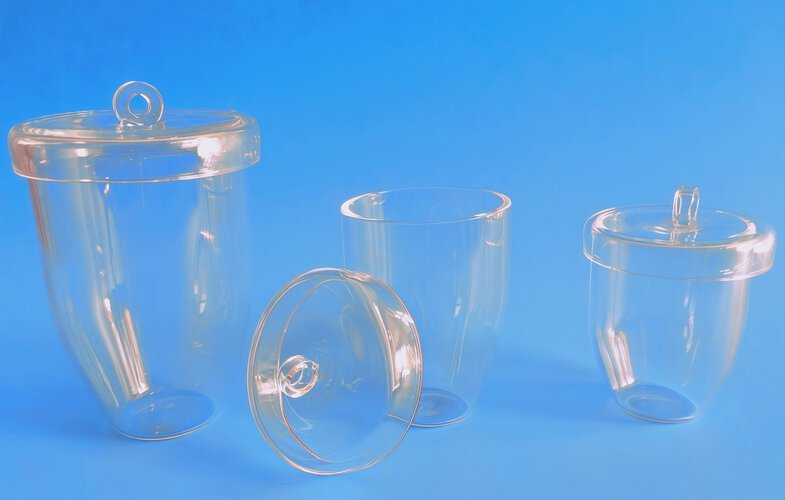
Quartz crucibles are manufactured using high-purity silica, which provides high-temperature resistance, low impurities and good thermal stability. They are extensively utilized in a variety of applications, including the drawing of photovoltaic single crystalline silicon, semiconductor wafer manufacturing, and high-temperature reactions in chemical laboratories. Its acid and alkali resistance can directly impact its expected lifespan and safety. In the field of photovoltaics, for instance, if the crucible is corroded by acid or alkali, impurities may be introduced, potentially resulting in a decline in the quality of silicon wafers. Consequently, the scientific testing of the acid and alkali resistance of quartz crucibles is a fundamental aspect of product development and quality control.
- Preparations before testing
- Sample preparation
Representative quartz crucibles are to be selected, then cut into small samples. The edges of these should then be smoothed over to ensure that stress concentration is avoided. The removal of oil stains can be achieved through the use of ultrasonic cleaning with anhydrous ethanol.
- Reagents
Concentrated hydrochloric acid, sulfuric acid, nitric acid, sodium hydroxide, deionized water.
- Instrument
Electronic balance, constant temperature water bath, scanning electron microscope (SEM), inductively coupled plasma optical emission spectrometer (ICP-OES), X-ray photoelectron spectrometer (XPS), roughness meter.
- Acid resistance test
SiO2 displays excellent stability in the majority of acids, with the exception of hydrofluoric and concentrated hot phosphoric acid. The test method is designed to identify surface corrosion marks and any alterations in quality of quartz crucibles.
- Static immersion method
Weigh the initial mass of the sample, and fully immerse it in a 20% H2SO4 solution. Then, soak the sample in a constant temperature water bath at 60°C for 24 hours. Following removal, it should be rinsed with deionized water, dried at 120°C, and weighed. The resultant data should then be compared with the initial mass.
- Auxiliary characterization
The presence of holes, cracks or corrosion pits on the surface should be observed using SEM. The elemental composition of the surface should then be analyzed using XPS, and the changes in the surface Ra value before and after immersion should be compared.
- Alkali resistance test
- Static immersion method
Weigh the initial mass of the sample, fully immerse the sample in a 10% NaOH solution, and soak it in a constant temperature water bath at 80℃ for 24 hours. Take it out, rinse and dry it, then weigh it and compare it with the initial mass.
- Solution analysis
The concentration of silicon ions in the solution after immersion is then measured using ICP-OES. It is a simple fact that the higher the concentration, the more severe the corrosion.
- Morphology and mechanical characterization
Observed by SEM, if white silicate precipitates or peeling appear on the quartz surface, it indicates obvious corrosion.
- The key factors influencing test results
- The purity of quartz
High-purity quartz (over 99.99%) contains fewer impurities, and its corrosion resistance is far superior to that of ordinary quartz. Impurities can accelerate acid-base reactions.
- Test condition
For every 10°C increase in temperature, the rate of alkaline corrosion increases by 2 to 3 times. The higher the initial concentration of the quartz glass being corrosive, the more severe the corrosion.
- Surface states
Polished surfaces demonstrate higher resistance to acids and alkalis in comparison to rough surfaces. Rough surfaces have a large contact area and are prone to local corrosion.
The acid and alkali resistance test of quartz crucibles is a complex procedure which should involve static immersion, chemical analysis and morphological characterization. The performance of the crucibles should be comprehensively judged through multiple indicators. Ensuring the standardization of the test conditions (e.g. concentration, temperature and time) is imperative to ensure reliable and repeatable results. For instance, for high-purity quartz crucibles used in photovoltaic applications, the mass loss rate after soaking in 20% acid for 24 hours should be less than 0.1%, and the Si4+ concentration after soaking in 10% alkali for 24 hours should be less than 10 mg/L. In addition to guiding product selection, these data provide a foundation for the optimization of quartz crucible production, including purity enhancement and surface treatment.