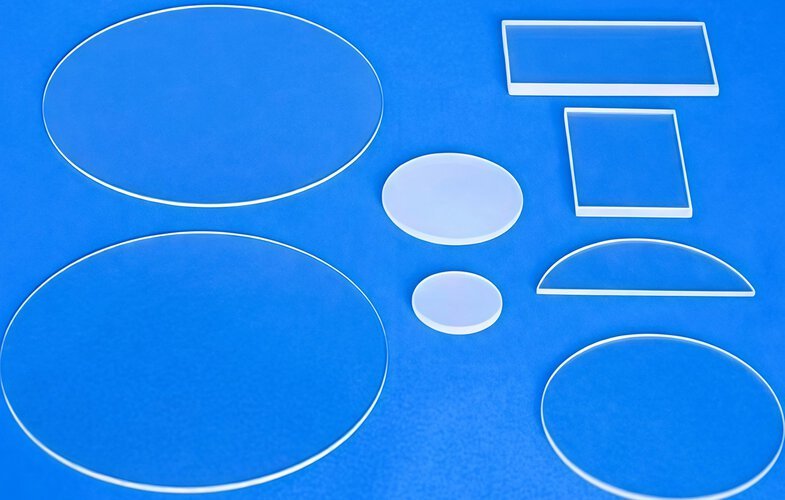
The necessity of edge processing
- Stress dispersion
Following the cutting process, quartz often exhibits sharp edges and micro-cracks. These characteristics render the material susceptible to stress concentration points, which can lead to breakage when exposed to high temperatures or impacts. Edge treatment has been shown to disperse stress and enhance impact resistance.
- Operational safety
Sharp edges can cause damage to operators. Following treatment, the risk of safety hazards can be reduced.
- Environmental resistance
In corrosive or high-temperature environments, smooth edges can reduce the adhesion of contaminants and extend the service life.
- Analysis of common edge processing types

Edge grinding treatment
Edge grinding is a fundamental edge processing method, which is divided into three stages.
- Coarse grinding
Remove cutting burrs and irregular edges to lay a foundation for subsequent processing.
- Accurate grinding
Smooth the edges and reduce the surface roughness.
- Polishing
Routinely refine the edges to a smooth finish, thereby minimizing dust adhesion and stress concentration.
- Advantage
The process is simple, low-cost and convenient.
- Disadvantage
In the event of inadequate polishing, microcracks may persist and become more prevalent under prolonged exposure to high temperatures.
Chamfering treatment
Chamfering is divided into right-angle chamfering and round chamfering (R Angle).
- Right-angle chamfer: In order to minimize the risk of scratches and localized stress, sharp edges and corners should be removed.
- Round chamfer:The edge boasts a smooth curve that enhances stress dispersion and offers superior impact resistance.
- Advantage: Enhance safety and extend service life.
- Disadvantage: The processing time for round chamfering is relatively long and the cost is slightly higher.
Rounded corner treatment
The edges have been completely rounded off to create smooth transitions without any sharp corners. This method disperses stress to a certain extent, prevents cracking and improves adhesion to the sealing ring, thereby enhancing vacuum/high-pressure sealing performance.
- Advantage: It features excellent sealing effect, stress dispersion and good high-temperature stability.
- Disadvantage: The processing is challenging, necessitates CNC machinery and carries a relatively high cost.
Flame polishing treatment
The edge is heated using a hydrogen-oxygen flame to melt the quartz, and then re-solidified, resulting in a surface that is smooth and crack-free. It can eliminate micro-cracks, enhance light transmittance and is suitable for optical-grade glass.
- Advantage: It boasts an excellent surface quality and good light transmittance.
- Disadvantage: The use of professional equipment is essential. Without proper control measures, it is susceptible to deformation.
The process of edge treatment of quartz glass must be determined after full consideration of the equipment scenario, performance requirements and cost. A reasonable handling method enhances sealing and lifespan while ensuring safety. When selecting a solution, it is essential to choose one that is tailored to specific requirements in order to achieve the desired performance of quartz glass.