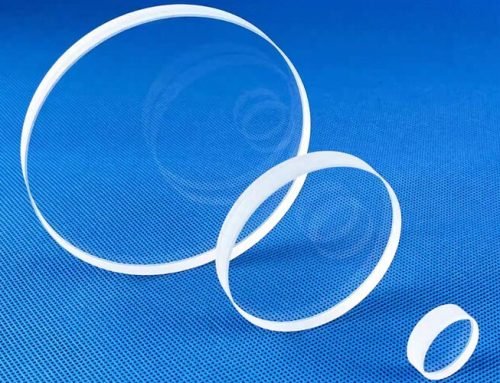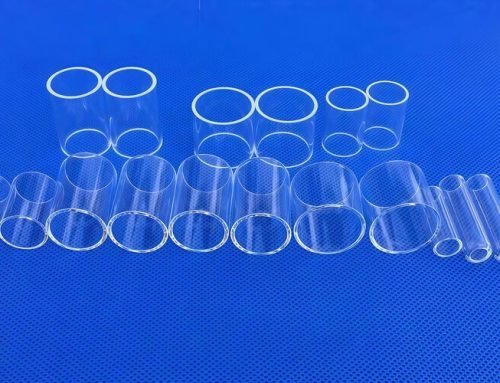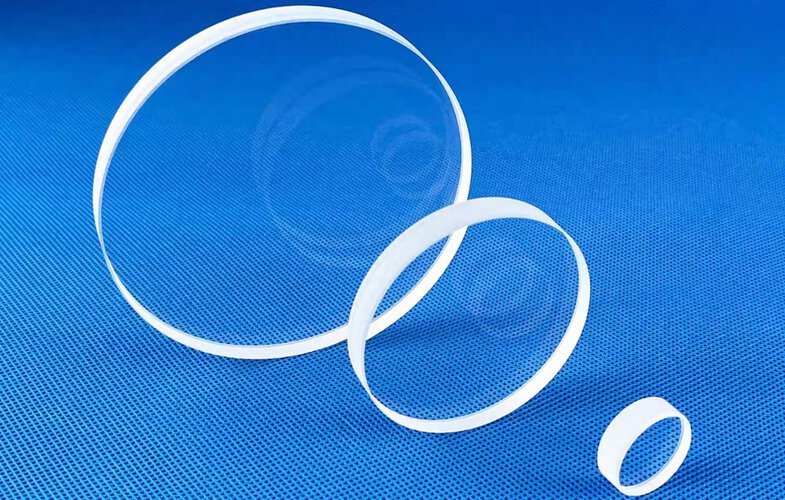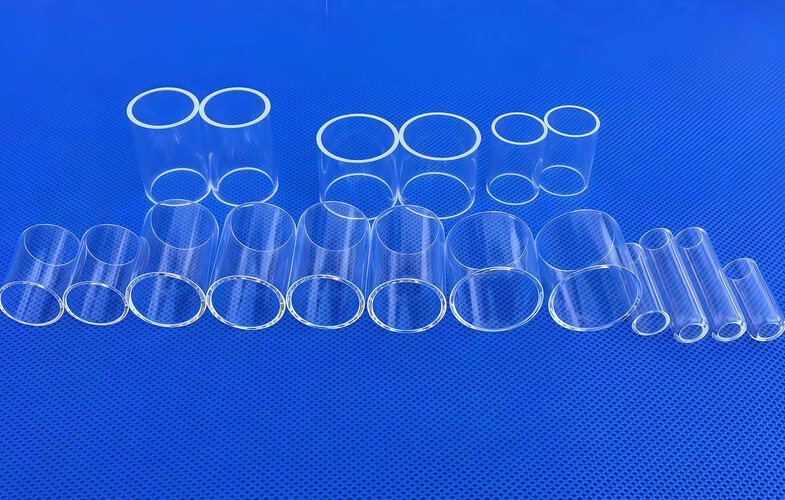

Quartz flange tube is a type of tube connection component manufactured by subjecting high-purity silica to high-temperature melting and precise processing. It plays a vital role in socket, sealing and structural transition in a range of equipment, including semiconductor, photovoltaic, optical fibre communication and chemical experiment equipment. As a significant segment of the deep processing sector of quartz glass, the technical capacity of quartz flange tube manufacturing directly impacts the dimensional precision, thermal stability, and service longevity of the final product.
- The basic material properties of quartz flange tubes
The performance of quartz flange tubes is based on the raw material used in their manufacture, namely high-purity quartz sand. Quartz sand is melted using either the high-temperature arc method or gas smelting method, forming transparent or semi-transparent quartz glass ingots. Subsequently, tubular components with flat flange rings are manufactured using mechanical drilling, flaring and end face grinding. In high-temperature application scenarios such as diffusion furnaces or oxidation furnaces, quartz flange tubes are required to possess an extremely low thermal expansion coefficient and demonstrate excellent resistance to thermal shock. This approach ensures that the raw material purification process prioritizes indicators such as hydroxyl content and metal impurity content, as these directly influence the crystallization temperature and softening point of quartz glass.
- Key quality controlin the production process of flange tubes
While there are some variations in the production processes of different quartz flange tubes, the core steps generally involve blanking, hot forming, cold working and annealing. Firstly, the tube blank is cut to the required length on a lathe. The tube opening area is then softened by flame heating. Subsequently, a graphite or metal mold is used for flaring and flanging to form a smooth sealing surface. It is also important to note that the annealing process should not be overlooked. It is imperative that the cooling curve is set according to the wall thickness and diameter to prevent the risk of micro-cracks forming at the tube ends.
- The industry cognitive basis of dimensional tolerance and appearance inspection
In the quality inspection process of quartz flange tube production, dimensional measurement and appearance inspection are routine control items. It is imperative that the outer and inner diameters, tube wall thickness and end face verticality of the flange are re-checked individually using vernier calipers, micrometers and a dedicated inspection platform. With regard to appearance, the allowable range of defects is generally based on industry communication practices. For instance, bubbles with a diameter of less than 0.5mm that are not densely distributed can be regarded as acceptable. However, it is imperative to remove defects such as cracks, chipped edges and cloud-like crystallization.
It is important to note that when selecting quartz flange tubes, users should not only consider the smoothness of the outer surface, but also verify the presence of any potential wall thickness variations on the inner wall resulting from uneven blowing processes. Due to the potential for significant variations in wall thickness, there may occur local stress concentrations, which could compromise the sealing reliability of the flange end in conditions of alternating cold and hot environments.
Quartz flange tubes are typically described according to four key parameters. These are: tube diameter (outer/inner diameter), wall thickness, flange outer diameter and flange thickness. Producers will select the appropriate flanging temperature based on the tube diameter. In instances where flange tubes feature larger wall thicknesses, it is advisable to consider auxiliary hot patching during the flanging process. This is to prevent any reduction in thickness at the tube opening.
The production of quartz flange tubes is a process that requires precise coordination between materials science and thermal processing. Its quality is influenced by multiple factors, such as the purity of raw materials, thermal processing techniques, and the accuracy of subsequent cold processing. Comprehension of the manufacturing logic involved in the production of quartz flange tubes assists users in evaluating product quotations and improving acceptance methods, preventing the evaluation of quality solely based on appearance, color or weight.