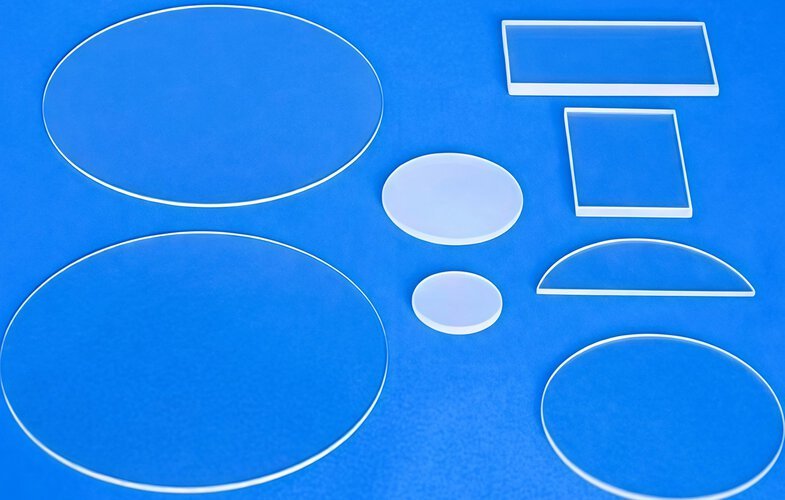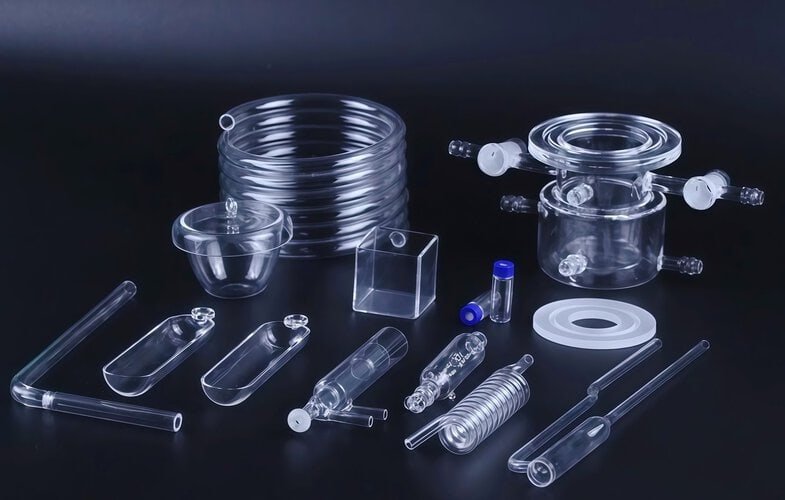

Grooved quartz plates represent a distinct category of quartz products that have been subject to a specific series of mechanical processes, resulting in the formation of regular grooves on the surface or edge of the quartz plate. Its wide range of applications extends to fields such as optics, semiconductors, photovoltaics and scientific research experiments. Its fundamental principle is to establish a basis for subsequent assembly or functional realization, facilitated by precise geometric dimensions and stable surface quality.
From the perspective of processing principles, quartz material is characterized by its relatively high hardness and brittle, hard texture. The conventional metal-cutting methods are not applicable to the process of slotting, necessitating the utilization of CNC machine tools in conjunction with diamond grinding wheels or laser cutting apparatus. The depth, width of the groove and the smoothness of the groove wall are all dependent on the grit size of the grinding wheel, the feed rate and the flow rate of the coolant. This process is a classic removal technique for brittle materials, which requires precise parameter control to avoid the formation of micro-cracks or chipping.
The quality control system for slotted quartz plates generally encompasses three aspects: inspection of incoming materials, process monitoring and testing of the finished product. The primary function of incoming material inspection is to verify the purity, light transmittance and the absence of internal bubbles or impurities in quartz raw materials. Process monitoring involves the use of online measurement equipment to provide real-time feedback on the groove shape dimensions, ensuring that each grinding operation adheres to the established tolerance range. The finished product testing involves a thorough inspection using an optical microscope, as well as profilometer measurement and surface cleanliness assessment after ultrasonic cleaning.
In terms of the processing methods, the common classifications of slotted quartz plates can be divided into mechanical slotting and laser slotting. Mechanical slotting is suitable for wider and deeper grooves, with good edge verticality, but there may be tiny tool marks. Laser grooving is an ideal solution for fine grooves or irregular paths, offering a smaller heat-affected zone. However, the surface finish of the groove wall is occasionally slightly inferior to that of mechanical processing.
There are at least three key factors to consider when assessing the quality of slotted quartz plates. Firstly, the thermal stability and chemical inertness of quartz material itself determine whether internal stress is prone to occurring after processing. Secondly, the rigidity of the equipment and the accuracy of the spindle directly impact the straightness and consistency of the slot. Thirdly, environmental cleanliness is crucial for preventing the adsorption of particulate matter on the surface of quartz glass.
In the semiconductor industry, slotted quartz plates are frequently utilized as the foundation for wafer support or etching mask sheets. The slot positions must be precisely aligned with the wafer pins, so the dimensional tolerances are usually controlled at the micrometer level. In the field of optics, slotted quartz plates are utilized for the precise placement of slots within optical fibre arrays. The requirement for uniform slot spacing and smooth slot bottoms is essential to minimize light loss.
In summary, the manufacturing process of slotted quartz plates involves the transformation of raw quartz materials into components characterized by precise geometric features. This transformation process involves multiple interdisciplinary fields, including mechanical processing, materials science and measurement technology. It is vital for users to understand the basic principles of slotting processing and the key points of quality control. This will enable them to put forward demands more accurately and evaluate product quality.