
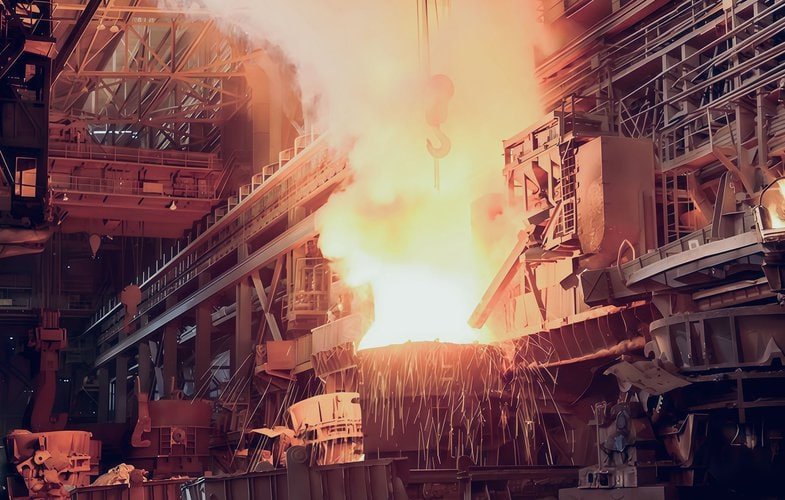
Quartz, as a critical non-metallic mineral material, has been extensively utilized in the metallurgical industry due to its unique physical and chemical properties. Quartz instruments, that is, various types of equipment and tools primarily composed of quartz, play an indispensable role across multiple stages of metallurgical production. This article will provide a detailed explanation of the characteristics of quartz materials and their applications within the metallurgical industry.
- The characteristics of quartz materials
- High heat resistance
Quartz exhibits a melting point as high as 1713℃ and can maintain stable physical and chemical properties in high-temperature environments, which makes quartz instruments suitable for high-temperature metallurgical processes.
- Excellent chemical stability
Quartz is characterized by its ability to withstand corrosion, making it resistant to a wide range of acids, alkalis, and salts. This property ensures its long-term durability in harsh chemical environments.
- Excellentlight transmission
Quartz exhibits a high transmittance for ultraviolet and infrared rays, which gives quartz instruments unique advantages in optical detection and high-temperature observation.
- Low coefficient of thermal expansion
Quartz has an extremely low coefficient of thermal expansion, meaning it can withstand drastic temperature changes without cracking easily. This makes it suitable for metallurgical environments with large temperature fluctuations.
- High mechanical strength
Quartz is a material characterized by its relatively high hardness and wear resistance, as well as its ability to withstand certain mechanical shocks and wear.
- The application of quartz instruments in the metallurgical industry
Quartz is an essential material in the metallurgical industry due to its unique properties, making it a key component in various instruments and equipment.
- High-temperature smelting and purification
One of the core processes in the metallurgical industry is the smelting and purification of metals. Quartz crucibles are the ideal containers for high-temperature smelting due to their high heat resistance and chemical stability. For instance, quartz crucibles are an essential component in the purification process of rare metals such as titanium, zirconium and tantalum. These crucibles are able to withstand high temperatures and prevent contamination by impurities, ensuring the purity of the metals. In addition, quartz crucibles are also widely used in the preparation of semiconductor materials, such as the drawing process of monocrystalline silicon.
- Gas purification and transmission
In the metallurgical process, the purity of gases and the transmission efficiency have a significant impact on product quality. Quartz tubes are often used in gas purification systems and high-temperature gas transmission pipelines due to their high-temperature resistance and corrosion resistance. For instance, in metallurgical furnaces, quartz tubes can be used to transport inert gases such as argon and nitrogen to protect molten metal from oxidation. In addition, quartz tubes can also be used in high-temperature chemical reactors, such as ammonia decomposition and hydrogen reduction processes.
- High-temperature observation and monitoring
In the metallurgical process, real-time monitoring of the conditions inside the furnace is crucial for optimizing process parameters and improving product quality. Quartz plates are extensively utilized as observation windows in high-temperature furnaces, owing to their exceptional light transmittance and high-temperature resistance properties. Through the quartz window, operators can directly observe the molten state, reaction process and temperature distribution of the metal inside the furnace, and thus adjust the process parameters in a timely manner.
- Sample loading and heat treatment
In metallurgical laboratories, quartz boats are frequently utilized for the transportation of samples during high-temperature heat treatment or sintering experiments. For instance, quartz boats are capable of withstanding high temperatures during the sintering process of metal powder, thereby preventing sample contamination. Furthermore, quartz boats are an excellent solution for the reduction of metal oxides, including iron ore.
With its exceptional thermal and chemical stability, quartz instrumentation contributes significantly to metallurgical processes. From high-temperature smelting to gas purification, and from furnace observation to sample handling, quartz instruments are integral throughout the production chain. As technology continues to advance, the application prospects for quartz instruments in the metallurgical industry are expected to expand further. In the future, these instruments will continue to support the industry’s development toward greater efficiency, environmental sustainability, and long-term viability.