Quartz instruments play a crucial role in new energy research. Owing to their unique physical and chemical properties, quartz materials are extensively utilized in the development, testing, and optimization of new energy technologies. Their high purity, thermal stability, corrosion resistance, low thermal expansion coefficient, and excellent electrical insulation properties make them indispensable in this field. The following analysis details the key functions of quartz instruments and their specific applications in new energy research.
- Applications in solar cell research
Solar cells represent an essential element of new energy technology, with quartz instruments playing a pivotal role in research and development and the manufacturing of solar cells. The core material of solar cells is silicon, and quartz is one of the main raw materials used in the manufacturing of high-purity silicon. Quartz crucibles play a crucial role in the manufacturing process of solar cells, where they are used for the smelting and purification of silicon. Their high-temperature resistance, excellent chemical stability, and inability to react with silicon ensure the purity and quality of silicon materials.
- Applicationsin lithium-ion battery research
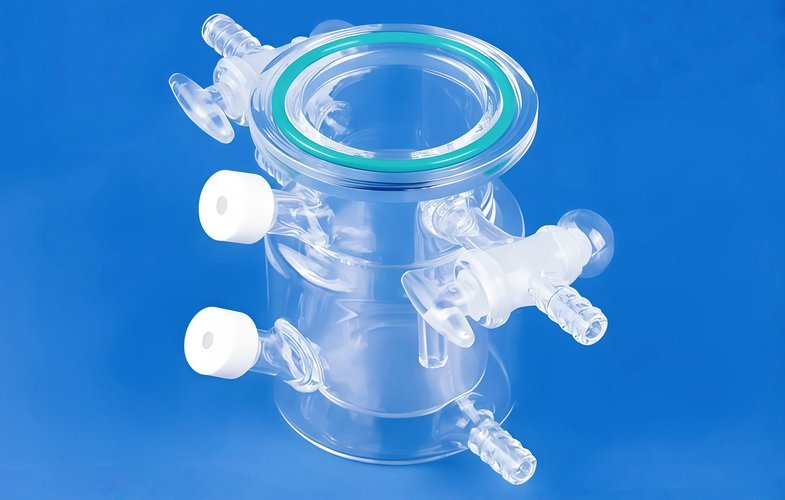
Lithium-ion batteries represent a key component of new energy storage technology, with quartz instruments also playing a significant role in the research and development of lithium-ion batteries. In the research of electrode materials for lithium-ion batteries, quartz crucibles are used for high-temperature synthesis of electrode materials. Quartz reactors are used for synthesizing and purifying electrolytes, while quartz electrodes are used for the conductivity and electrochemical stability tests of electrolytes. In addition, quartz tubes and films are used in the research of separators for lithium-ion batteries. This helps to optimize the ion transport performance and mechanical strength of the batteries.
- Applications in hydrogen energy research
In recent years, hydrogen energy has garnered significant attention as a clean and efficient energy source. Quartz instruments have emerged as essential tools in multiple facets of hydrogen energy research. In water electrolysis technology for hydrogen production, quartz electrodes are used to investigate catalyst performance and reaction mechanisms. Owing to their exceptional chemical stability and electrical conductivity, these electrodes maintain operational stability under highly acidic or alkaline conditions, thereby enabling researchers to optimize the efficiency of electrolytic hydrogen generation.
- Applications in nuclear energy research
Nuclear energy, as an efficient form of new energy resources, relies critically on quartz instruments throughout its research and development. In nuclear reactors, quartz glass is utilized for manufacturing observation windows and sensor components that enable precise monitoring of operational parameters and temperature variations. The exceptional radiation resistance and thermal stability of quartz glass establish it as an ideal material for observational and monitoring applications within nuclear reactor environments.
- Applications in biomass energy research
Biomass energy represents a significant renewable energy source, with quartz instruments playing a crucial role in related research applications. In biomass pyrolysis and gasification processes, quartz reactors are used to investigate reaction mechanisms and optimize process parameters. Quartz tubes are additionally utilized for purification and compositional analysis of biomass-derived gases, thereby enhancing the overall efficiency of biomass energy utilization.
- Conclusion
Quartz instruments play an indispensable role in new energy research. Their exceptional physical and chemical properties establish them as critical materials in the development of new energy technologies, including solar cells, lithium-ion batteries, hydrogen energy, nuclear energy, and biomass energy. From material synthesis to performance test, from reaction mechanism investigation to safety evaluation, quartz instruments provide essential capabilities across all phases of energy research. As energy technologies continue to advance, the applications and significance of quartz instruments are expected to expand further, offering robust support for the innovation and advancement of new energy technology.