- The main welding methods of quartz glass
The process of welding quartz glass involves partially melting and bonding quartz materials using high temperatures. The following are some of the most common methods.
- Flame welding method
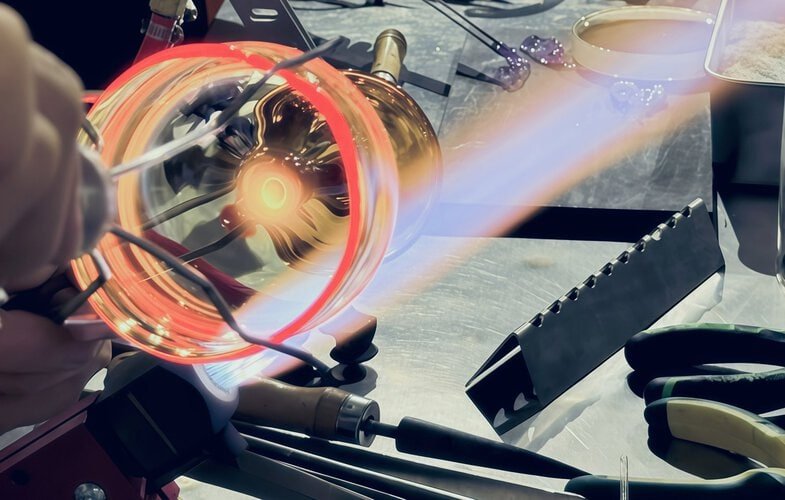
The quartz glass joint is then heated using a hydrogen-oxygen flame or an oxygen-acetylene flame in order to melt it, after which it is spliced. This method features simple equipment and versatile operation, making it ideal for the connection of medium and small-diameter quartz glass. It is imperative to maintain precise control over the flame temperature to prevent local overheating, which could lead to quartz glass fracture.
- High-frequency induction welding method
Local fusion welding is achieved by generating eddy currents and heat at the quartz glass joint through high-frequency electromagnetic fields. This method features uniform heating and fast speed, making it suitable for mass production. However, the equipment cost is relatively high and it is essential that it matches the size and shape of the quartz glass.
- Laser welding method
A high-energy laser beam is focused on the welding area to instantly melt the quartz material. Laser welding offers distinct advantages in terms of its ability to generate a smaller heat-affected zone and attain higher precision. These characteristics make it well-suited for welding quartz glass with small thickness and intricate structures. However, it has strict requirements for equipment and operational techniques.
- Plasma welding method
The high temperature of the plasma arc melts quartz, making it suitable for welding large-thickness quartz glass or large-sized joints. The welding strength of this method is high, but it is important to control the stability of the plasma arc.
- Key precautions for quartz glass welding
Quartz material is characterized by brittleness, substandard thermal conductivity and a low coefficient of thermal expansion. However, it is highly sensitive to thermal stress. Therefore, the following links in the welding process need to be strictly controlled.
- Material purity and matching
The purity of quartz glass directly impacts the quality of welding. High-purity quartz is characterized by minimal impurities, excellent fluidity upon melting, and exceptional joint strength. The presence of impurities can lead to undesirable outcomes such as bubbles, cracks or crystallization at the welding point.
It is imperative that the purity of the two materials that require welding at the joint is matched. In the process of welding quartz glass, it is of utmost importance to select quartz that is of the same or a similar purity. When welding with metals, transition layers such as metallic quartz or master alloys should be used to prevent stress cracks resulting from excessive differences in thermal expansion coefficients.
- Temperature and heating control
It is imperative that the heating temperature reaches the melting point of quartz, which is approximately 1750°C. However, it is important to avoid excessive heating. Excessively high temperatures can cause quartz to decompose or undergo local deformation. Conversely, insufficient temperatures will result in an ineffective welding of quartz.
It is also important to ensure that the heating is uniform. Quartz is characterized by its poor thermal conductivity, which can easily result in local overheating and thermal stress. This, in turn, can lead to the formation of cracks. When performing flame welding, it is essential to use a circular flame or a moving flame in order to ensure uniform heating around the joint circumference. Induction welding requires precise adjustment of coil position to ensure uniform magnetic field distribution.
- Stress relief and cooling
Annealing treatment is required after welding. The parts should be heated to 1000-1200°C (the annealing temperature of quartz), held for a period of time, and then cooled slowly to eliminate the internal stress generated during the welding process and prevent cracking.
It is important to avoid rapid cooling. Direct exposure to air during cooling can result in a rapid decrease in temperature, thereby intensifying stress concentration, an issue of particular concern for thin quartz glass, which is more susceptible to damage as a result.
- Welding quality inspection
- Appearance inspection
The surface of the joint should be smooth, without cracks or bubbles.
- Sealing performance test
Ensure that there is no leakage at the joint through air pressure or water pressure tests.
- Strength test
Tensile and bending tests should be conducted on the welded parts in order to verify that the joint strength meets the required specifications.
- Microanalysis
The internal structure of the joint was observed under a microscope to confirm whether the molten area was uniform and free of defects.
Welding quartz glass is a viable option, however, the most appropriate welding method should be selected based on the specific application scenario. It is essential to strictly control the material purity, surface treatment, temperature and cooling process. The correct welding process is vital for ensuring the sealing and strength of the joint, as well as extending the service life of quartz glass. In practice, it is essential to optimize the welding parameters in conjunction with specific requirements to ensure that the welding quality meets the necessary standards.